
Cognitive Behavioural Therapy (CBT)
Change the way you feel by changing the way you think. CBT is a structured, goal-oriented approach that helps you identify unhelpful thought patterns and develop practical tools for lasting emotional change.
What is Cognitive Behavioural Therapy?
Cognitive Behavioural Therapy (CBT) is a structured, goal-oriented form of psychotherapy that focuses on the connection between your thoughts, feelings, and behaviours. Based on the principle that our thoughts influence our emotions and actions, CBT helps you identify and challenge unhelpful thinking patterns.
"CBT is present-focused and collaborative. Rather than spending extensive time exploring the past, it equips you with practical tools you can use immediately."
You and your psychologist work together as a team. Therapy sessions include discussions, exercises, and homework assignments designed to help you apply new skills in your daily life to manage current difficulties effectively.
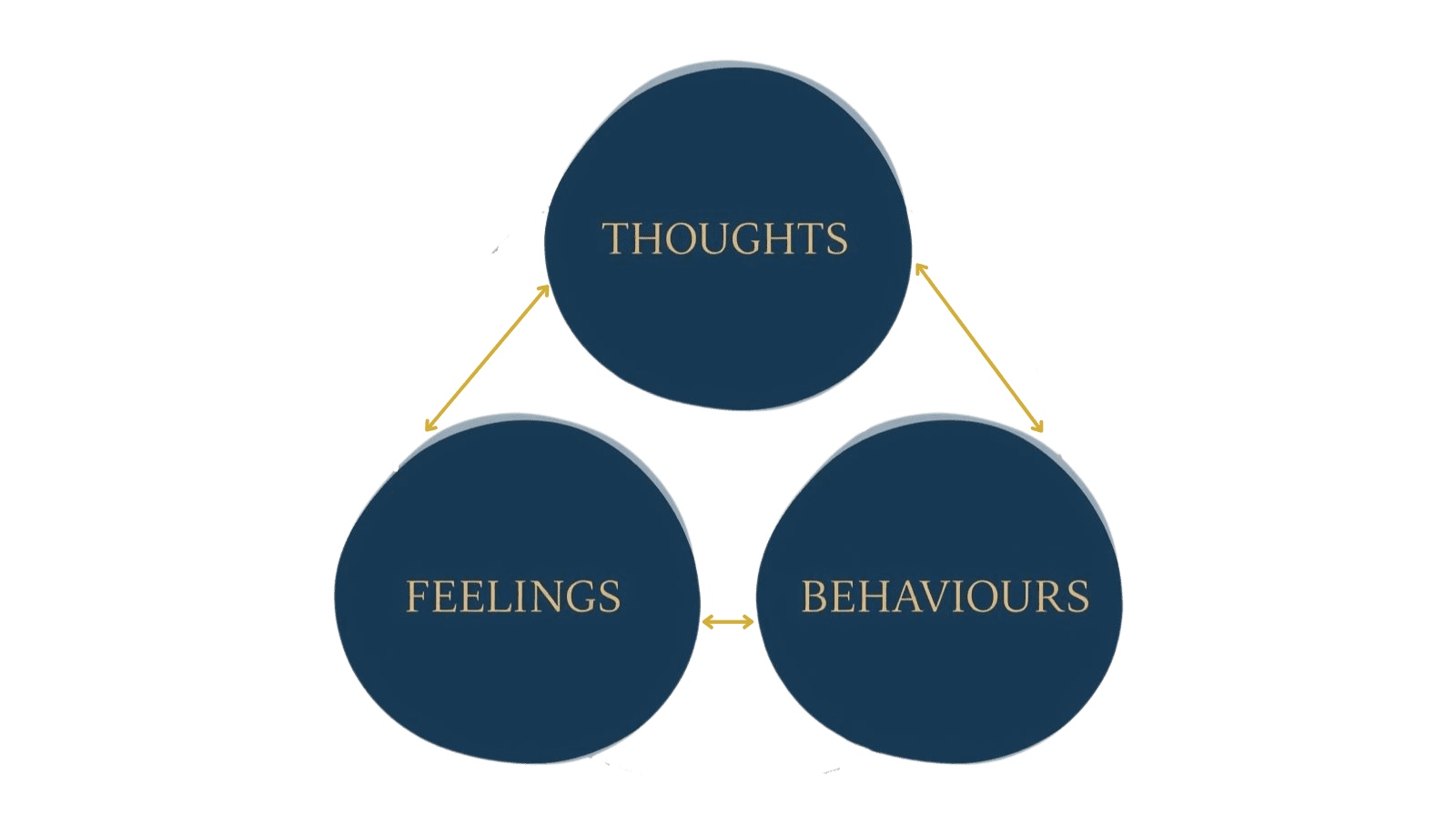
The CBT triangle illustrates the interconnected relationship between thoughts, feelings, and behaviours.
THE CBT TRIANGLE

What Conditions Does CBT Help?
CBT is one of the most extensively researched forms of psychotherapy and is clinically recognized for its effectiveness in managing a wide range of concerns:
Anxiety Disorders
- Generalized Anxiety (GAD)
- Social Anxiety
- Panic Disorder
- Specific Phobias
- Health Anxiety
Mood Disorders
- Depression
- Persistent Depressive Disorder
- Seasonal Affective Disorder
- Low Self-Esteem
Stress & Transitions
- Work Stress & Burnout
- Life Transitions
- Relationship Conflicts
- Adjustment Difficulties
Health & Wellness
- Insomnia & Sleep
- Chronic Pain Management
- Anger Management
- Perfectionism
Not sure if your specific concern is covered?
While the list above covers the most common conditions, CBT is a highly flexible approach. We can discuss your unique situation during an initial consultation.
Inquire About Your Condition →What Does CBT Involve?
CBT is a structured, skills-based approach. Rather than just talking about problems, we actively work on the mechanics of how thoughts and behaviors maintain them.
Identifying Patterns
Learn to recognize "automatic thoughts" and cognitive distortions—like catastrophizing or black-and-white thinking—that influence your emotions and behaviours.
Testing & Challenging
Examine the evidence for and against your beliefs. Through "behavioural experiments," we test the accuracy of these thoughts to develop more balanced, realistic perspectives.
Skill Development
Develop a practical toolkit: thought records, problem-solving, and grounding techniques. Structured "homework" between sessions helps consolidate these skills into daily life.
The Practical Toolkit
Thought Records • Behavioural Activation • Problem-Solving • Relaxation & Grounding • Assertiveness Skills
Your Journey: What to Expect
CBT is collaborative and measurable. We follow a clear roadmap to ensure you are seeing real-world progress in your symptoms and quality of life.
Phase 1: Assessment & Planning (Sessions 1-2)
We conduct a comprehensive assessment to understand your history and identify specific problems. Together, we establish measurable objectives and a personalized treatment plan.
Phase 2: Active Treatment
Each session follows a consistent, productive structure:
Phase 3: Maintenance & Ending
As you gain independence, sessions are spaced further apart. We develop a relapse prevention plan, ensuring you have the tools to remain your own psychologist long after therapy ends.
Evidence Base: Why CBT Works
Scientific Recognition
- ★ Over 2,000 randomized controlled trials demonstrate effectiveness.
- ★ Recommended as a first-line treatment by NICE (UK) and the APA (USA).
- ★ Supported by Singapore’s Ministry of Health.
Lasting Neural Change
CBT works because it addresses both thinking patterns and behaviours. By learning practical skills, you become your own psychologist.
Brain imaging studies show that CBT produces measurable changes in brain activity, often more lasting than medication alone.
View Clinical References [+]
2. National Institute for Health and Care Excellence (NICE). Depression in adults: treatment and management. Clinical guideline [NG222].
3. Butler, A. C., et al. (2006). The empirical status of cognitive-behavioral therapy: A review of meta-analyses. Clinical Psychology Review.
Experience Evidence-Based Care
Join many others who have found support through this clinically recognized approach. At Mind Health, we apply research-backed protocols to help you manage your symptoms effectively.
Schedule a Consultation →Specialized Applications
Beyond General Therapy: CBT-I
Because CBT is so effective at changing patterns, specialized protocols have been developed for specific challenges. One of the most successful is CBT-I, the gold-standard treatment for chronic sleep difficulties.

The restorative nature of the CBT-I program helps reset your natural sleep health.
CBT for Insomnia
Unlike general therapy, CBT-I is a brief, 4-to-8 session program that targets the specific biological and psychological factors that maintain insomnia. It is recommended as the first-line treatment for chronic sleep issues.
- Resetting your natural "Sleep Drive"
- Breaking the cycle of sleep-related anxiety
- Stimulus Control & Sleep Restriction therapy
Understanding the Differences
While many therapies overlap, CBT has distinct characteristics. Here is how it compares to other common psychological approaches:
CBT vs. Psychodynamic Therapy
While psychodynamic therapy focuses on unconscious processes and past experiences, CBT is present-focused and emphasizes current thinking and behaviour patterns. CBT is typically shorter-term (12-20 sessions) and includes structured homework.
CBT vs. Traditional Counselling
Counselling often provides emotional support and space to explore feelings. CBT is more directive and skills-focused, teaching specific techniques to change patterns. Both involve a supportive relationship, but CBT focuses on active skill-building.
CBT vs. Mindfulness (MBCT)
Mindfulness teaches acceptance and present-moment awareness. Traditional CBT focuses more on actively challenging and changing thoughts. At Mind Health, we often integrate these approaches based on your needs.
CBT vs. Acceptance and Commitment Therapy (ACT)
CBT aims to change unhelpful thoughts, while ACT teaches you to accept difficult thoughts while taking valued action. CBT is often more suitable if your primary goal is to directly reduce distressing symptoms.
CBT vs. EMDR
EMDR is specifically designed for trauma processing using bilateral stimulation. CBT uses cognitive restructuring and behavioural techniques. For trauma, EMDR may work faster, though CBT is also effective with trauma-focused adaptations.
Is CBT Right for You?
CBT may be particularly helpful if you resonate with the following:
Getting Started with CBT at Mind Health
Our psychologists are trained in CBT and adapt the approach to your unique needs, cultural background, and preferences. We offer CBT in both English, Mandarin and Cantonese , ensuring you can engage in therapy in your most comfortable language.
Ready to begin? Contact us today to schedule an initial consultation and discover how CBT can help you achieve your goals.
Begin your journey →