
Support for Eczema & Skin conditions in Singapore
The skin is the body’s largest organ and a direct mirror of our internal state. When the skin is in a state of constant flare, the mind cannot remain at peace. We provide integrative support to help you break the itch-scratch cycle.
The Clinical Spectrum of Skin Distress
While often viewed through a cosmetic lens, chronic skin conditions are complex, systemic inflammatory disorders where the immune system and the nervous system are in constant, stressful communication. At MIND HEALTH, we provide support for the following primary presentations:
Atopic Dermatitis (Eczema): The most common form of skin inflammation, characterized by a compromised barrier and intense pruritus (itching). It is often cyclical, where environmental triggers lead to flares that disrupt sleep and daily focus.
Psoriasis: An autoimmune condition that accelerates the life cycle of skin cells, leading to thick, silvery scales and painful, red patches. The visible nature of psoriasis often leads to significant social withdrawal and “hiding” behaviors.
Chronic Acne: Often persisting well into adulthood, inflammatory acne is deeply tied to hormonal and stress-related triggers. It frequently carries a heavy emotional burden related to self-image and permanent scarring.
Other Conditions: We also offer support for Rosacea, Hives (Urticaria), and Vitiligo, focusing on the emotional regulation required to manage chronic, visible symptoms.
The Singapore Landscape: A Silent Crisis
In Singapore, chronic skin conditions represent a staggering clinical burden. Approximately 1 in 10 adults and 20% of school-going children suffer from Atopic Dermatitis (Eczema), making it the most common skin disorder in the country (National Atopic Dermatitis Program, 2022).
The Tropical Challenge: Our relentless heat and high humidity (often >80%) trigger profuse sweating, which irritates the skin barrier and fosters dust mite allergens—the most potent trigger in Singapore. This environment creates a physical discomfort that is virtually inescapable.
The Mental Health Connection: Local clinical research indicates that the psychological impact is profound. A study at the National Skin Centre found that among Singaporean patients with moderate-to-severe eczema, significant proportions were identified as clinical cases for anxiety and depression, with higher disease severity correlating directly to greater psychological burden (Lim et al., 2016).
References:
Lim, V. Z., Ho, R. C., et al. (2016). “Anxiety and Depression in Patients with Atopic Dermatitis in a Southeast Asian Tertiary Dermatological Centre.” Annals, Academy of Medicine, Singapore.
National Skin Centre Singapore (2022). “National Atopic Dermatitis Research Program.”
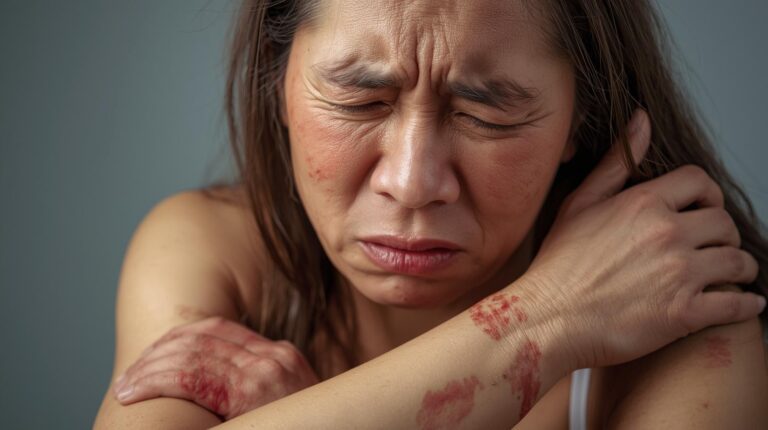
The Emotional Landscape: Beyond the Itch
Living with chronic skin distress is a full-time cognitive load. It is not merely the physical sensation of pain; it is a pervasive impairment that dictates your daily choices, your social identity, and your internal peace.
The Cycle of Hypervigilance: Sufferers often live in a state of constant “scanning”—evaluating fabrics, temperatures, or ingredients. This hypervigilance keeps the nervous system on high alert, which ironically further inflames the skin. This often forces the abandonment of passions; a person may give up sports or the outdoors simply to avoid the sting of sweat or environmental triggers.
Maintenance Burnout: There is a silent exhaustion in the relentless “soak and smear” routines. When your morning and evening are dictated by medical necessity rather than self-care, it leads to a specific burnout where you feel enslaved by your own skin, leading to impaired focus and a diminished sense of agency.
Stigma, Rejection & Loneliness: The visible nature of flares often attracts the “Contagion Myth”—where strangers flinch or move away on public transport. Fear of being judged for “scratching to the point of bleeding” leads to social withdrawal and “hiding behaviors.” Over time, this erosion of social space creates deep vulnerability and chronic loneliness, making it increasingly difficult to form close, supportive relationships.
At MIND HEALTH, we provide a safe space to process this social trauma and help you move from a state of “hiding” to reclaiming your functional confidence.
The psychological burden of skin distress is heavy, but you do not have to carry it alone.
Start Your Journey to Emotional Relief
TCM Perspectives on Skin Conditions
Traditional Chinese Medicine (TCM) views the skin as an external reflection of the body’s internal equilibrium and organ health.
The Lung-Skin Connection: In TCM theory, the Lungs are the primary organ governing the skin and hair. They are responsible for distributing “Wei Qi” (Defensive Energy) to the surface. When Lung Qi is deficient, the skin’s protective barrier weakens, making it vulnerable to environmental irritants and persistent flares.
Internal Heat and Dampness: Skin conditions characterized by redness, swelling, and oozing are often identified as manifestations of “Heat” or “Damp-Heat.” This signifies an inflammatory state within the body—often involving the Liver or Heart systems—where excess heat “overflows” to the skin surface.
Blood Dryness and Yin Deficiency: For chronic cases where the skin is thick, scaly, and extremely dry, TCM identifies this as “Blood Dryness” or “Yin Deficiency.” This indicates that the body’s internal fluids are insufficient to nourish and moisten the skin, leading to a loss of elasticity and persistent, parched irritation.

Evidence-based Psychological Support
Managing a chronic skin condition requires more than just topical treatment; it requires a specialized psychological toolkit to manage the neurological and emotional triggers that fuel the cycle of distress.
CBT
We address the “Itch-Scratch Cycle” by identifying the automatic thoughts and environmental cues that lead to scratching. By restructuring these patterns, we aim to lower the physiological arousal that exacerbates inflammation.
ACT
ACT helps develop psychological flexibility. Rather than fighting a flare-up, we work on mindfulness and value-based living, ensuring your skin condition no longer dictates your ability to pursue a meaningful life.
Empowerment through Acceptance
HRT
Specifically for chronic “habitual” scratching, Habit Reversal Training (HRT) helps you develop awareness of premonitory urges and implement “competing responses” to protect the skin barrier.
Targeted Behavioral Change
These interventions are not about “curing” the skin, but about empowering you to navigate the condition with resilience, reducing the psychological impact
A Different Approach to Skin Health
At MIND HEALTH, we recognize that your skin does not exist in a vacuum. While traditional treatments focus solely on the surface, we address the neurological and emotional architecture that sustains chronic flares.
By combining evidence-based psychological support with a perspective informed by TCM principles, we help you break the cycle of hypervigilance and social withdrawal. We don't just treat symptoms; we help you reclaim the life that your skin condition has narrowed.
Frequently Asked Questions
Does this replace my dermatologist's treatment? +
No. Our support is complementary to your medical treatment. While your dermatologist manages the physical skin barrier, we help you manage the psychological triggers, the itch-scratch habit, and the emotional stress that can cause your medical treatments to be less effective.
How many sessions will it take to see an improvement? +
Psychological change is a process. Most clients begin to notice a shift in their "hypervigilance" and stress levels within 6 to 8 sessions. However, the goal is long-term management and reclaiming your quality of life, which varies for every individual.
What if I am already using TCM herbs or acupuncture? +
That is perfectly fine. Our psychological interventions (CBT/ACT) do not interfere with TCM. In fact, reducing emotional "Heat" through therapy often aligns well with the goals of TCM practitioners.
Ready to address the emotional side of your skin health?
Schedule a ConsultationPsychodermatology in Singapore: Clinical Interventions for Chronic Skin Distress
Chronic skin conditions—such as Atopic Dermatitis, Psoriasis, and TSW (Topical Steroid Withdrawal)—are more than dermatological concerns; they are neurobiological events. At MIND HEALTH, we treat the Brain-Skin Axis to break the cycles of systemic inflammation and psychological impairment.
The Neurobiology of the Itch-Scratch Cycle
The sensation of "itch" (Pruritus) is processed by the same neural pathways as pain. Chronic scratching induces Neural Sensitization, where the brain becomes hyper-responsive to even minor skin sensations. This creates a feedback loop: stress triggers the release of Substance P and pro-inflammatory cytokines, which directly degrade the skin barrier, leading to further irritation and psychological distress.
TCM Pathophysiology of Skin Disorders
Defensive Qi & The Lung System
In Traditional Chinese Medicine, the Lungs govern the Wei Qi (Defensive Energy). A deficiency in Lung-Qi manifests as an incompetent skin barrier (intercellular lipid depletion), leaving the body vulnerable to external 'Wind' and 'Pathogens'—clinically seen as allergic flares and environmental sensitivities.
Systemic Heat & Blood Stasis
Erythema (redness) and acute inflammation are categorized as Internal Heat. When stress becomes chronic, it leads to 'Liver Qi Stagnation,' which generates heat that 'scortches' the blood, resulting in the thickened, lichenified skin textures seen in chronic eczema cases.
Evidence-Based Clinical Modalities
Cognitive Behavioral Therapy (CBT)
Utilizing Stimulus Control and Cognitive Restructuring to manage the 'itch-anticipation' anxiety. We target the automaticity of scratching behaviors to allow the epidermal layer to heal without constant mechanical trauma.
Learn more about CBT →Habit Reversal Training (HRT)
A structured 3-phase intervention focusing on Awareness Training, Competing Response Development, and Social Support. HRT is the gold standard for reducing non-productive scratching and skin-picking disorders.
Clinical FAQ
How does psychological intervention affect skin barrier function?
By lowering cortisol levels and inhibiting the sympathetic nervous system's "fight-or-flight" response, therapy reduces the neuro-genic inflammation that causes mast cell degranulation and skin barrier breakdown.