
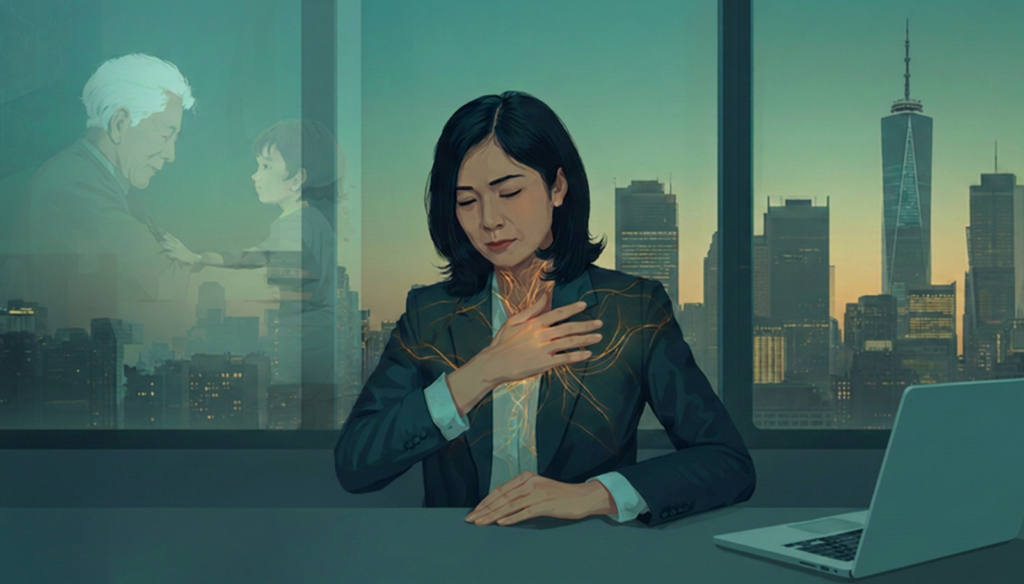
Between Your Parents and Your Kids, Who’s Taking Care of You?
Welcome to Part 1 of The Sandwiched Body series – where clinical psychology meets Huangdi Neijing. Over the next 10 weeks, I will be exploring how the intense stress of the “sandwiched generation” (juggling corporate KPIs, aging parents, and young children) physically manifests in our bodies. By bridging modern Clinical Psychology with the ancient wisdom of the Huangdi Neijing (黄帝内经), we will unpack the mind-body connections behind your daily physical symptoms—and how to heal them.
Picture the 7pm MRT crowd. Half of them are the sandwiched generation — hitting corporate KPIs by day, managing a parent’s medication schedule by evening, and helping with homework before bed. No real gap in between.
In my practice, I see the same story on repeat. Someone comes in exhausted in a way that sleep doesn’t fix. Aches that move around the body. Headaches that show up out of nowhere. A stomach that’s never quite settled. They go for a full workup — bloodwork, scans, the works — and everything comes back clean. So they tell themselves it’s nothing, and they push through.
(To protect client confidentiality, what follows draws on patterns I’ve seen across hundreds of clients — not any one person’s story.)
The Neijing has a line for this: it’s like digging a well only once you’re already thirsty(渴而穿井)or forging a weapon only once the battle has started (斗而铸锥). In other words — by the time the body is shouting, the problem has usually been building quietly for a long time.
Here’s what I think is really going on with the sandwiched generation: there’s rarely room to say out loud how tired, resentful, or grieving you actually feel. Not to your boss. Sometimes not even to your spouse. So the feeling doesn’t disappear — it just goes somewhere else. The Neijing describes this kind of unexpressed strain as something that “encircles the interior,” turning invisible pressure into something very physical. Your body isn’t malfunctioning. It’s protesting the only way it knows how.
The blind spot in how we treat this
Most healthcare still treats the body and the mind as two separate patients. You see a GP for the migraines and, maybe, a therapist for the stress — and the two of them never talk to each other.
Traditional Chinese Medicine (TCM) never made that split in the first place. The principle is called Xing Shen He Yi (形神合一) — the unity of form and spirit. Your physical state and your emotional state aren’t two different things that occasionally influence each other. They’re one system, described from two angles.
In clinical psychology, we describe this as somatization: when the mind has no more room to hold something, the body ends up carrying it instead. Combining both lenses in practice, we stop chasing symptoms in isolation and start looking for what’s actually feeding them.
Is it really an injury — or is it a message?
Try this quick check-in with yourself:
That knot in your neck, that tightness in your chest — is it really just your office chair? Or is it Liver Qi Stagnation (肝气郁结), the physical residue of frustration you’ve been swallowing at work for months?
Waking up at 3am with your mind racing — is that really the afternoon coffee talking? Or is your Heart Spirit (心神) simply too unsettled by everything you’re carrying to let you rest?
The Neijing puts it plainly: “the hundred diseases are generated by the disruption of Qi” (百病生于气也). Once you start asking whether a symptom might be a signal rather than just an injury, you’ve already taken the first real step toward dealing with the root instead of the surface.
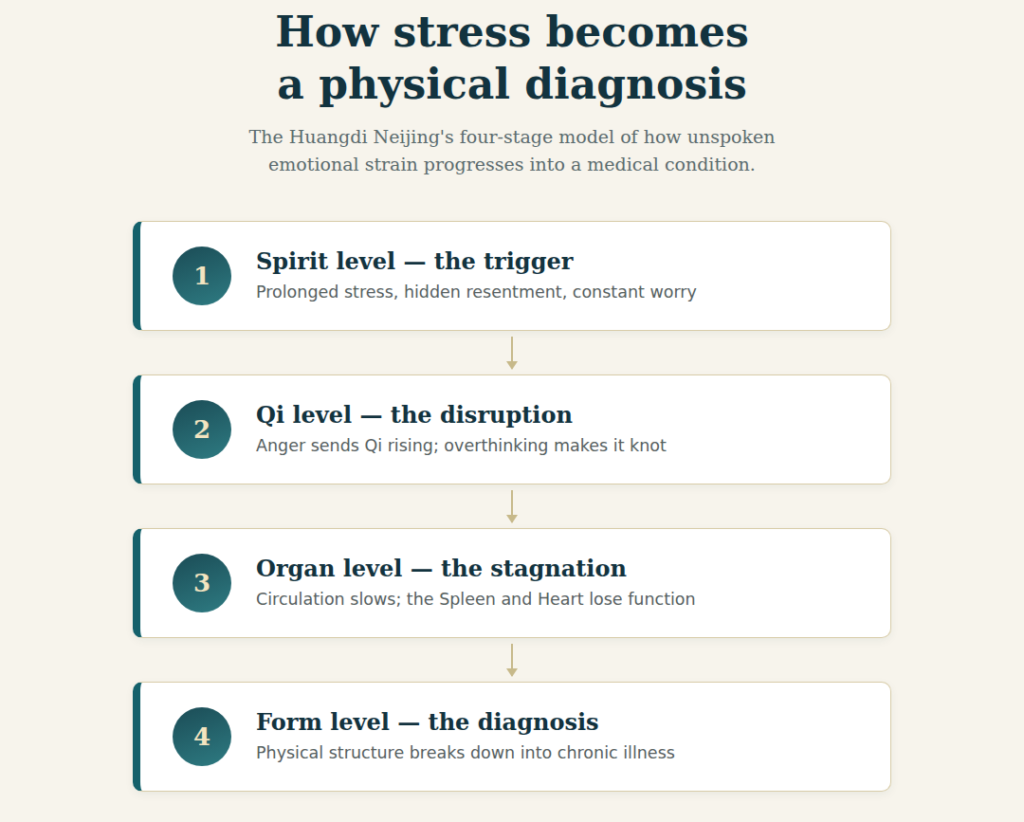
The Neijing actually maps out a fairly predictable path from feeling to illness:
Spirit → Qi → Organ → Form
(Emotional stress → energy disruption → circulation drops → physical illness)
1. Spirit level — the trigger. Ongoing stress. Resentment you haven’t voiced. Worry that never fully switches off.
2. Qi level — the disruption. The text is specific here: “anger causes the Qi to rise” — which is often the sudden headache or the clenched jaw. “Pensiveness and overthinking cause the Qi to knot together” — which tends to show up as that heavy, stuck feeling in the gut.
3. Organ level — the stagnation. Knotted or stagnant Qi means circulation slows down locally. Organs like the Spleen and Heart start losing their usual function.
4. Form level — the diagnosis. If nothing changes at the emotional level, the physical structure eventually gives way, and you end up with a chronic condition that has a name.
Four signals worth paying attention to
If you’re currently living the sandwiched life, these are the patterns I see most often:
Aches and pain — tension headaches, a jaw that won’t unclench, pressure behind the eyes. Usually shows up alongside frustration or boundaries that keep getting crossed. TCM describes this as rising Qi tension.
Brain fog — that sticky, foggy-headed feeling, bloating after meals, trouble focusing. In TCM terms, constant overthinking wears down the Spleen’s ability to process and convert energy.
Chronic fatigue — the kind of tiredness that isn’t physical so much as existential, where your drive just isn’t there anymore. This points to depleted Kidney energy, worn down by chronic worry, financial pressure, and overwork.
The lump in the throat — a persistent sensation you can’t swallow or clear, medically known as Globus pharyngeus and in TCM as Méi Hé Qì (梅核气). It tends to show up when there are words — or grief — you haven’t let yourself express.
The takeaway
You cannot look after your parents or your kids from an empty tank. That’s not a metaphor — it’s how the body actually works.
Don’t wait until the well runs completely dry before you start digging. If any of this sounds familiar, it might be worth treating it as information rather than an inconvenience.
—
If you’re a healthcare practitioner, a corporate wellness lead, or you’re simply living the sandwiched life right now, I’d love to hear your thoughts — and I’ll be continuing this series over the next few weeks. Follow along if this resonated.
—
References
Huangdi Neijing Suwen (黄帝内经·素问), Chapter 1 — Treatise on Heavenly Truth in Remote Antiquity: on prevention over crisis response.
Huangdi Neijing Suwen (黄帝内经·素问), Chapter 39 — Treatise on Clarifying Pain: on how specific emotions affect the body’s Qi.
Xing Shen He Yi (形神合一) — the TCM framework for understanding Qing Zhi Bing (情志病), emotional-somatic disorders linked to burnout and chronic stress.
Méi Hé Qì (梅核气) — the classical description of emotional stagnation manifesting physically, closely paralleling modern understanding of somatic symptom disorder and autonomic dysregulation.
“Explore an Integrative Path to Wellbeing — Schedule a Consultation with Dr. Jaswyn Chin”
About the Author
Dr. Jaswyn Chin
Doctor of Psychology (Clinical) | Registered Clinical Psychologist
Dr. Jaswyn Chin is a Registered Clinical Psychologist and Approved Supervisor in Singapore. As a pioneer in Psychology-TCM integration, she specializes in evidence-based therapies (CBT, EMDR, MBCT) for complex health conditions, trauma, and mood disorders