
The Future of Healing: Why the East-Meets-West Mind-Body Approach is the New Clinical Gold Standard
Over the last nine parts, we’ve traced your headaches, your locked-up back, your 3am wake-ups, and your quiet burnout back to the same source: the collision of corporate pressure, caregiving weight, and boundaries you never got to set. None of it was ever really a mechanical failure. It was always your body keeping score.
So here’s the question this finale is actually about: what would it look like if healthcare treated that seriously, instead of treating each symptom as its own disconnected complaint?
One Person, Not Three Specialists
Picture walking into a clinic with a stiff lower back, an unsettled stomach, and an exhaustion that sleep doesn’t touch. Instead of being routed to three specialists who never speak to each other — a muscle relaxant here, an antacid there, a generic “manage your stress” on the way out — you’re met by a single, coordinated approach that treats your physical body and your emotional state as one connected system, because that’s what they’ve been the whole time.
This isn’t a new idea dressed up in new language. It’s closer to a return to something medicine used to understand more intuitively, before specialization split the body into unconnected departments. Some clinicians borrow language from an existing integrated model in cardiology — sometimes called “Double Heart” treatment, originally developed for patients navigating heart disease alongside depression or anxiety — and apply that same logic more broadly: the vessel and the spirit were never actually two separate patients.
In this kind of care, clinical psychology does the work of untangling unconscious threat responses and rebuilding the boundaries that kept getting crossed. TCM does the work of physically unfreezing what’s been locked in place — easing stagnation, calming an overactive nervous system, and slowly restoring a depleted foundation. Neither one is decoration for the other. Both are doing real, necessary work.
Why You Actually Need Both — But One Comes First
Treating someone this depleted with only one toolkit tends to fail in a specific, predictable way, depending on which one you leave out.
Lean purely on the physical side — medication, physiotherapy, acupuncture, herbs, adjustments, however skillfully done — and the relief tends to be real but temporary, because the person goes home to the exact same unmanaged chaos that caused the depletion in the first place.
This is worth sitting with, because it’s the actual argument for why psychology isn’t just one equal ingredient here: TCM can clear stagnation, and Western medication can calm an overactive nervous system, both beautifully. But if the boundary failure that caused that stagnation and that overactivation is never addressed, the same pattern simply reaccumulates.
Root and Tip: An Old Idea Worth Reviving
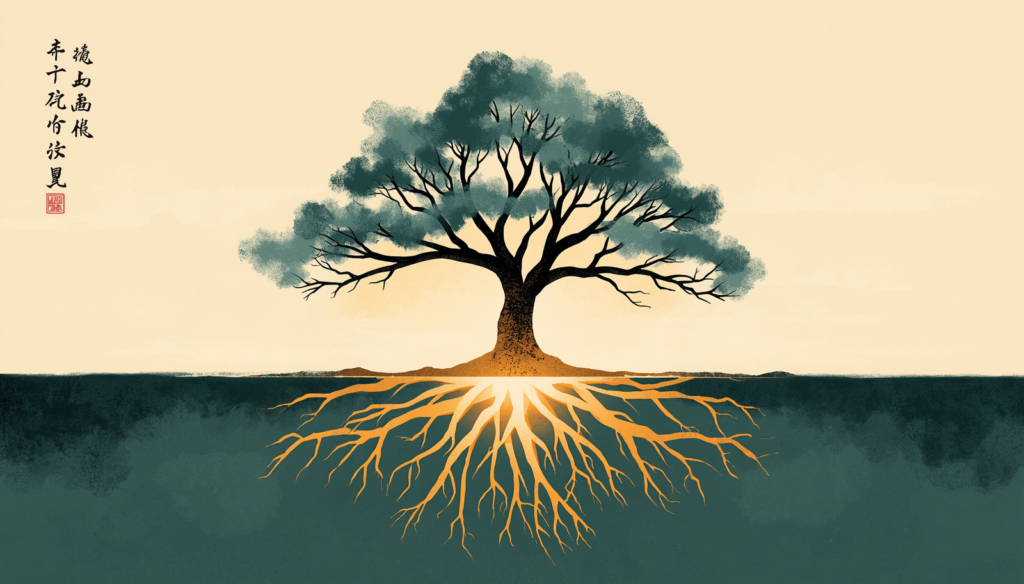
Classical TCM has a specific term for exactly this distinction. The Suwen (素问), Chapter 65 (标本病传论), lays out the principle of Biāo Běn (标本) — Tip and Root. The Tip is the loud symptom in front of you: the sharp ache, the racing heart, the crushing headache. The Root is what’s actually driving it — and across this entire series, the Root has almost always turned out to be the same thing: a boundary that never got held.
Treating only the Tip gets you temporary quiet. Treating the Root is where things actually resolve — and treating the Root is clinical psychology’s job.
Naming a drained reserve doesn’t stop whatever’s still draining it, and the thing doing the draining is almost always a psychological pattern, not a physical one.
That’s not a knock against Western medicine or TCM. It’s a case for sequencing. Physical treatment brings the nervous system down enough that a person can actually do the deeper work. But the deeper work — untangling the unconscious threat response, dismantling the belief that your worth is tied to being everyone’s resilient cushion, rebuilding an actual capacity to hold a boundary — is where the pattern actually stops repeating. Without that piece, you’re managing symptoms indefinitely rather than resolving what’s producing them.
Three Pillars for Moving Forward
If you’ve followed this series, you already recognize the pattern in your own body. Here’s how the pieces fit together, in the order they actually need to happen:
Boundary work, first and ongoing. This is the foundation everything else depends on. Examining why your sense of worth got tied to being everyone’s reliable cushion, and rebuilding the capacity to actually hold a line instead of quietly absorbing the next thing asked of you — without this, the other two pillars only ever offer temporary relief.
Somatic awareness. Learning to catch your body’s defensive bracing while it’s happening — the pelvic drop, the extended exhale — interrupts the pattern in the moment, buying you room to do the deeper work.
Energetic regulation. TCM herbal prescriptions, acupuncture, or targeted acupressure support the physical side of recovery — clearing stagnation, calming the nervous system, rebuilding a depleted foundation — but work best alongside the boundary work, not as a substitute for it.
Closing
If modern physiology can show that chronic hypervigilance produces measurable muscular bracing, and a few-thousand-year-old text was already describing a strikingly similar pattern using its own vocabulary, it’s worth asking why we’d insist on choosing only one lens to look through.
Your health isn’t a side project running alongside your career and your family. It’s the foundation underneath both. You don’t need a total collapse to justify taking that seriously — the whispers were always enough of a reason.
If any part of this series described a pattern you recognized in your own body — the headaches, the sighing, the 3am wake-ups, the brain fog — that recognition is worth taking seriously. It’s usually the first real sign that the Root, not just the Tip, needs attention.
Being a clinical psychologist, this is exactly the kind of work I do: integrating clinical psychology with a genuine, working knowledge of TCM, for people who are holding two generations together and have been quietly running on empty for longer than they’d like to admit. If that’s you, know that you don’t have to keep managing this alone. Simply reach out to me.
Thank you for following along with The Sandwiched Body — where clinical psychology meets the Huangdi Neijing — over these ten weeks. I hope it leaves you with the clarity to actually voice your boundaries, the patience to rebuild what’s been depleted, and the self-compassion to put yourself first.
References
Suwen (素问), Chapter 65 — 标本病传论 (Treatise on the Root, Tip, and Transmission of Disease): the source of Biāo Běn, the principle of treating both the presenting symptom and its underlying cause.
Explore an Integrative Path to Wellbeing — Schedule a Consultation with Dr. Jaswyn Chin
About the Author
Dr. Jaswyn Chin
Doctor of Psychology (Clinical) | Registered Clinical Psychologist
Dr. Jaswyn Chin is a Registered Clinical Psychologist and Approved Supervisor in Singapore. As a pioneer in Psychology-TCM integration, she specializes in evidence-based therapies (CBT, EMDR, MBCT) for complex health conditions, trauma, and mood disorders