
When “Baby Blues” Isn’t the Full Story
Last week, I wrote about MP Elysa Chen‘s call in Parliament for routine postpartum support—both physical and mental. That conversation stayed with me, because in my clinical practice, I see how often the “mental” aspect gets treated as an afterthought or dismissed as something a mother should simply “push through.”
I want to go deeper into why this happens.
The Perfectionist’s Wall
“Jenny” (not her real name), a senior executive I worked with, came to me struggling with postpartum depression. Aside from a profound sadness, she described feeling completely disconnected from herself. She was no longer the sharp, composed professional who always “had it together.”
She had longed for her baby, yet she wasn’t happy. She was exhausted from broken sleep and late-night feedings, caught in a constant guessing game of deciphering baby cries, overwhelmed by conflicting parenting advice, and consumed by anxiety that she wasn’t giving her baby the best care. She described a hollow exhaustion no amount of rest could fix. For a high achiever used to being the steady one, that internal disconnect felt like structural failure.
It wasn’t failure. It was biology.
Two Different Things Get Lumped Together
Up to 80% of new mothers experience the “baby blues”—mood swings, tearfulness, and anxiety that peak in the first week and resolve on their own within fortnight.
Postpartum depression is fundamentally different:
- It affects roughly 1 in 5 to 1 in 10 mothers.
- It does not resolve on its own.
- It requires active, structured support.
Too many mothers are told to “just enjoy the baby” when their experience has clearly crossed that line—and that dismissal delays the clinical care they actually need.
A Blood-and-Spirit Event, Not a Mindset Issue
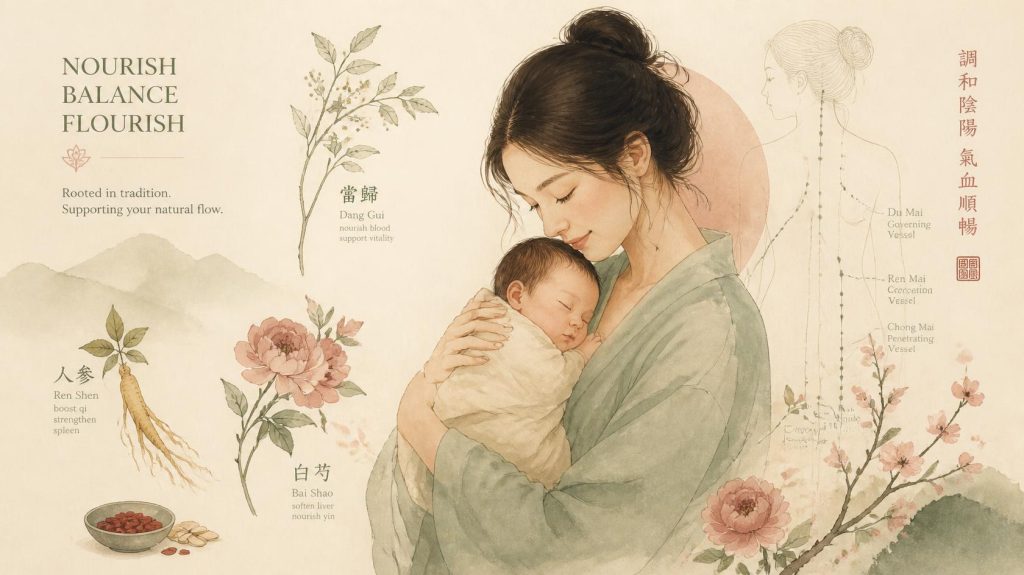
From a TCM perspective, Jenny’s Heart (the body’s “Empress,” housing the Shen, or spirit) and her Uterus (the Blood Chamber) had fallen out of sync. When delivery severely depletes Blood and Qi, the spirit has “nowhere to return.”
Modern research describes this exact phenomenon through a different lens: the gut-brain-microbiome axis, where post-birth inflammatory and microbial shifts correlate directly with postpartum mood disorders. Different language, same underlying pattern: the body’s physical depletion and the mind’s emotional distress are one single event.
Why This Isn’t Just About the Mother
This isn’t only about maternal well-being—though that alone should be reason enough. Research consistently shows that the mother-infant bond is what carries forward into a child’s development. Depression can temporarily reduce a mother’s capacity for the responsive, attuned interaction infants need to build secure attachment. In fact, one recent study found that bonding difficulties accounted for over a third of the link between maternal depressive symptoms and a child’s later emotional challenges.
This is not a cause for guilt. It is the strongest possible argument for early intervention, before physical depletion turns into emotional disconnection. When a mother gets help early, the bond has room to recover—and so does the child.
What Integrated Care Actually Looks Like
This is why I advocate for a coordinated model alongside TCM physicians, rather than forcing a mother to navigate separate, fragmented care tracks on her own:
- On the Psychology side: Cognitive behavioral strategies (CBT) are helpful in challenging the “perfect mother” thinking, reframing exhaustion as a physiological signal of depletion rather than a personal failure.
- On the TCM side: Physicians utilize targeted herbal formulations to rebuild Blood and nourish Qi. Where appropriate, acupuncture is integrated. One clinical trial of 85 women found acupuncture combined with psychological support achieved an effective rate comparable to fluoxetine (90.7% vs. 90.5%) with zero adverse effects in the acupuncture group—though broader meta-analyses show mixed results, reflecting an evolving evidence base.
The goal isn’t replacing one modality with another. It’s building a care team that treats the mind and body as one integrated system.
A Note on Clinical Urgency
While most postpartum distress sits on a spectrum that responds well to integrated care, postpartum psychosis—characterized by sudden confusion, hallucinations, or detachment from reality—is a rare (1–2 per 1,000 mothers) medical emergency. It requires immediate psychiatric care, not home-based management.
Why This Belongs in Policy
Routine postpartum checks, like those MP Elysa Chen advocated for, matter because they catch distress early—before baby blues quietly slip into untreated depression. A coordinated model bridging psychological and TCM care offers a practical, holistic template for what modern maternal healthcare should look like in Singapore.
Your postpartum health is the foundation for your family’s future. Let’s build a system where mothers don’t have to push through alone.
References:
- Huang H, Peng L, Zheng L, Wang L. Observation on therapeutic effects of acupuncture plus psychological intervention for postpartum depression. Journal of Acupuncture and Tuina Science (2014).
- Heliyon (2024). Epidemiological data on postpartum depression prevalence and mother-infant bonding outcomes.
About the Author
Dr. Jaswyn Chin
Doctor of Psychology (Clinical) | Registered Clinical Psychologist
Dr. Jaswyn Chin is a Registered Clinical Psychologist and Approved Supervisor in Singapore. As a pioneer in Psychology-TCM integration, she specializes in evidence-based therapies (CBT, EMDR, MBCT) for complex health conditions, trauma, and mood disorders