

You Treat Rest Like a Cost. TCM Treats It Like Capital.
(A note for high achievers still confusing exhaustion with commitment.)
Welcome to Part 9 of The Sandwiched Body series – where clinical psychology meets Huangdi Neijing. Over the last few months, this series has walked through a long list of “minor” things: the sleeplessness at 3:00AM, the brain fog, the involuntary groan when you stand up, the band of pressure around your skull, the morning your body simply refuses to get out of bed. You’ve probably told yourself each one is manageable on its own. And on any single day, it probably is. But none of these are isolated events. They’re stages of the same slow process, and the honest question isn’t whether you can push through today — it’s what you’re waiting for before you actually change anything.
The Collapse That Didn’t Have to Happen
The most tragic cases encountered in clinical practice are not those hit by sudden, unpredictable illnesses. They are the professionals who noticed the mild brain fog, the frequent sighing, and the lower back stiffness for years, but chose to label them as “just part of getting older.” They chose to ignore these signs and procrastinate on seeking help till it’s too late.
In the Huangdi Neijing (黄帝内经), the sages deliver a blistering warning to anyone operating under this illusion. In Chapter 2 (四气调神大论) of the Suwen (素问), they state: “夫病已成而后药之…譬犹渴而穿井,斗而铸锥,不亦晚乎!” — To apply medicine only after a disease has fully formed is like digging a well only when you are already parched, or forging weapons only after the battle has already begun. Isn’t that far too late?
This is the classical principle of Zhì Wèi Bìng (治未病) — treating what hasn’t yet become disease. It’s not a call for more meditation apps. It’s a direct challenge to the idea that “waiting for total collapse before you act counts as resilience”. It doesn’t. It counts as a deficit you haven’t noticed yet.
Why “Pushing Through” Is a Loan, Not a Strategy
Here’s the part that should actually worry a high achiever, more than the wellness framing usually lands: chronic, unaddressed stress doesn’t just make you tired. It measurably degrades the exact faculties you’re relying on to keep performing — working memory, decision speed, judgment under pressure. The thing you fear losing (your competence, your edge) is precisely what chronic depletion erodes first, quietly, before anything dramatic happens.
Researchers call the cumulative wear from this the allostatic load — the physiological cost of your stress-response systems running elevated for too long, rather than cycling back down to baseline the way they’re supposed to. It’s a real, measurable metric, and it accumulates whether or not you’re paying attention to it.
Using coffee and willpower to override a stiff back or a racing heart so you can clear your inbox isn’t managing your workload. It’s borrowing from a future version of yourself who’s going to need that capacity and won’t have it. TCM frames this as depleting your Jing — a deep, slow-to-replenish reserve. Whichever language you prefer, the mechanism is the same: you’re not getting this time for free.
Real self-care for the sandwiched generation isn’t a spa weekend. It’s closer to an honest audit: you cannot hold up the emotional and logistical weight of two generations if your own foundation is already running on fumes.
The Spectrum of Internal Deprivation
Stress doesn’t announce itself all at once — it moves through recognizable stages, from something you can barely notice to something you can’t ignore.
The whisper. Involuntary sighing, afternoon brain fog, a bit of nervous bloating after meals. This is early-stage Liver Qi constraint and mild Lung oppression — still reversible with boundary changes and breathwork, without needing anything more intensive.
The shout. Chronic tension headaches, a back that never quite unlocks, a body that runs cold in places it shouldn’t. This is autonomic hyperarousal settling into your tissues — still addressable, but it now needs active intervention: therapy, somatic work, targeted acupuncture, not just willpower.
The crisis. Adrenal flatlining, structural rigidity in the lower back, the kind of exhaustion that a weekend off does nothing for. At this stage you’re looking at a genuinely depleted foundation, and recovery takes real time and real intervention, not a long weekend.
Most people reading this are somewhere in the first two stages. That’s actually good news — it means there’s still room to change course before this becomes the third.
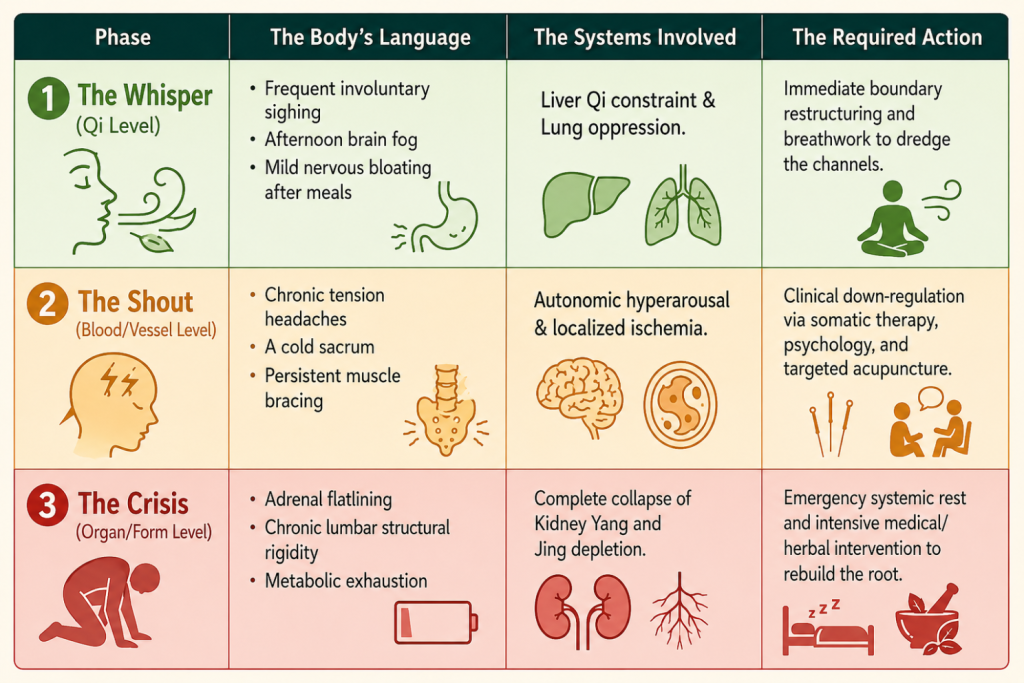
The Spectrum of Internal Deprivation
Warning Signs You Are Digging Your Well Too Late
If you experience any of the following signs, your body has already transitioned from a “whisper” to a “shout”:
- The involuntary groan. If standing up from your desk needs an audible sound effect or a few seconds to straighten out, your body’s already bracing hard enough to notice.
- Tension that returns within hours of a massage. If relief doesn’t last, the muscles aren’t the problem — your nervous system still reads your daily life as unsafe, and it’s re-clenching accordingly.
- Losing the line between your responsibilities and everyone else’s. When you can no longer tell what’s actually yours to carry versus what you’ve quietly picked up out of habit, your boundaries have thinned out enough to accelerate everything else on this list.
Your health isn’t a side project sitting next to your career and your family. It’s the foundation both of those are actually standing on. Waiting for a crack before you address it isn’t discipline — it’s just delaying a much more expensive repair.
Do you perceive resting as “being lazy” or “a waste of time”? Which “whisper” has your body been sending you over the past month that you have brushed off as minor?
Next week, in the final chapter of The Sandwiched Body series, we look at the ultimate shift in recovery: The Future of Healing — Why the East-Meets-West Mind-Body Approach is the New Clinical Gold Standard. Follow along for the grand finale.
References
- 《黄帝内经·素问》 (Huangdi Neijing Suwen): 四气调神大论 (Chapter 2: Treatise on Regulating the Spirit According to the Four Seasons) — The definitive classical source outlining the prevention principle of Zhi Wei Bing (治未病) and the famous metaphors of digging a well while thirsty and forging weapons during battle.
Explore an Integrative Path to Wellbeing — Schedule a Consultation with Dr. Jaswyn Chin
About the Author
Dr Jaswyn Chin
Dr. Jaswyn Chin is a Registered Clinical Psychologist and Approved Supervisor in Singapore. As a pioneer in Psychology-TCM integration, she specializes in evidence-based therapies (CBT, EMDR, MBCT) for complex health conditions, trauma, and mood disorders