
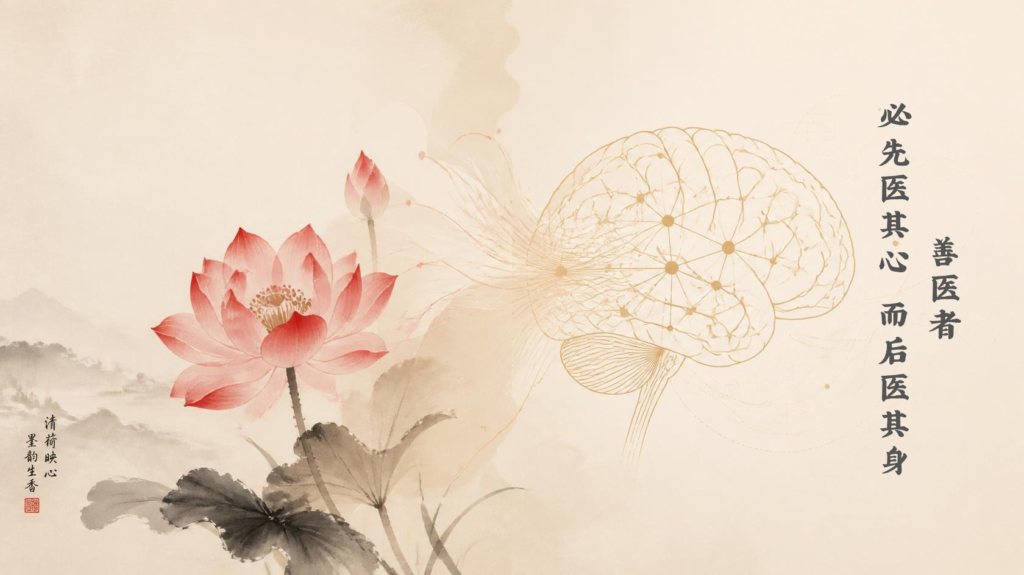
The Heart Before the Body: Why Classical TCM Wisdom Demands an Integrative Clinical Psychology Approach
As a clinical psychologist, I have witnessed firsthand how grief, anxiety, and unresolved emotional pain can manifest as physical illness. But it was a particular case that crystallized for me the profound truth embedded in classical TCM philosophy:
“善医者,必先医其心,而后医其身” “The skilled healer first treats the heart, and only then treats the body.”
This ancient wisdom, attributed to classical TCM texts, is not merely poetic sentiment. It is a clinical observation that modern research is only beginning to validate. And for those of us practicing in Singapore—many of us part of the sandwiched generation, caring for aging parents while raising children and managing demanding careers—this insight carries urgent practical implications.
The Case That Changed My Practice
A woman in her fifties presented with an aggressive form of ovarian cancer that had spread to her lungs. Her husband had died suddenly, leaving her alone without children. The grief she carried was complex, layered, and profound. She was referred to me by her oncologist for psychological support during her cancer treatment, and we worked together on processing her loss, building resilience, and finding meaning amidst her pain.
Her oncologist gave her a prognosis of one year. She survived two.
This is not a statistical anomaly. Research increasingly demonstrates that optimism, emotional resilience, and psychological support have tangible, measurable impacts on physiological recovery. Inflammation markers decrease. Immune function improves. Treatment adherence increases. The mind-body connection is not a metaphor—it is biology.
What Classical TCM Teaches Us About Integration
The classical TCM framework has always understood what Western medicine has only recently begun to embrace: emotional states directly influence physical health.
In TCM theory:
- Anger affects the Liver, leading to Qi stagnation
- Grief affects the Lungs, depleting Qi and weakening immunity
- Worry affects the Spleen, impairing digestion and energy production
- Fear affects the Kidneys, depleting foundational vitality
- Joy affects the Heart, and excessive joy can unsettle the spirit
The wisdom of “first treat the heart” is not a suggestion—it is a diagnostic and therapeutic imperative. When the heart is unsettled, the body follows. When the spirit is disturbed, no herb, no acupuncture needle, no surgical intervention can fully restore health.
The Sandwiched Generation: A Case Study in Heart-Body Disconnection
As professionals, many of us are already living this reality. We are the sandwiched generation—juggling the care of elderly parents, the needs of our children, the demands of our careers, and the quiet, persistent erosion of our own wellbeing.
Consider our own colleagues:
- The oncologist who treats cancer patients all day, then goes home to oversee her father’s dementia care
- The TCM physician who sees patients with stress-related conditions, while managing his own mounting anxiety about his children’s future
- The psychologist who holds space for others’ grief, yet has little room to process her own
We are treating bodies while our own hearts cry out for attention. We are prescribing herbs and medications while our own stress hormones remain chronically elevated. We are telling patients to prioritize self-care while we sacrifice our own sleep, our own meals, our own emotional health.
If we, as healers, cannot embody the principle of “first treating the heart,” how can we truly expect our patients to do the same?
The Case for Integrative Clinical Psychology and TCM
An integrative approach is not about replacing one system with another. It is about recognizing that different tools serve different purposes, and that the best outcomes arise from thoughtful, coordinated care.
Clinical Psychology brings:
- Evidence-based frameworks for understanding cognitive and emotional patterns
- Therapeutic modalities for processing trauma, grief, and anxiety
- Tools for building resilience, coping skills, and insight
- An understanding of how early life experiences shape adult health
TCM brings:
- A sophisticated framework for understanding the body’s energetic systems
- Diagnostic tools that detect imbalance before physical symptoms manifest
- Interventions that regulate the body’s physiological state
- Herbal and acupuncture protocols that have been refined over millennia
Together, they offer something neither can achieve alone:
- Evidenced-based psychological interventions (such as cognitive-behavioural therapy (CBT) and eye movement desensitization reprocessing (EMDR) therapy) help patients understand and transform the emotional patterns that drive illness
- TCM interventions provide the physiological foundation that makes psychological work possible
The patient with cancer and complicated grief needs both. She needs someone to help her process her loss—and she needs interventions that support her body’s capacity to fight disease. She needs a space where her emotional pain is treated with the same urgency as her physical symptoms.
Why This Matters Now, and Why It Matters to Us
The healthcare landscape in Singapore is changing. Patients are more informed, more discerning, and more demanding of holistic care. The rising prevalence of chronic disease, mental health conditions, and stress-related disorders means that a fragmented healthcare system is no longer fit for purpose.
But beyond the system-level imperative, there is a personal one.
As practitioners, we are the custodians of healing traditions that span cultures and centuries. We have the privilege and responsibility to integrate these traditions thoughtfully—not as a marketing exercise, but as a clinical commitment to better outcomes.
When we treat the heart first, we honour the person, not just the disease. When we treat the heart first, we acknowledge that healing is not mechanical, but relational. When we treat the heart first, we create the conditions for the body to follow.
A Call to Conversation
I am not suggesting that every TCM practitioner needs to become a psychologist, or that every psychologist needs to master acupuncture. What I am suggesting is that we need to understand each other’s languages, recognise each other’s contributions, and build referral networks and collaborative models that serve our patients better.
The woman in her fifties survived longer than expected because she received both medical treatment and psychological support. Her resilience was not innate—it was cultivated. Her optimism was not naive—it was hard-won through therapeutic work. And her body, given the right conditions, responded.
How many more patients could we help if we took the principle of “first treat the heart” seriously?
How many more colleagues might we support if we acknowledged that the sandwiched generation—including ourselves—needs both professional excellence and personal compassion?
I invite you to share your thoughts.
- How do you integrate mental health considerations into your practice?
- What collaborations have you found most effective?
- What barriers have you encountered in referring patients across disciplines?
- What would make integrative care more accessible to our patients and to ourselves?
Let us start a conversation that moves beyond theory and into practice.
The classical wisdom of “first treat the heart” is not an ancient relic. It is a contemporary call to action. Let us answer it together.
“Explore an Integrative Path to Wellbeing — Schedule a Consultation with Dr. Jaswyn Chin”
About the Author
Dr. Jaswyn Chin
Doctor of Psychology (Clinical) | Registered Clinical Psychologist
Dr. Jaswyn Chin is a Registered Clinical Psychologist and Approved Supervisor in Singapore. As a pioneer in Psychology-TCM integration, she specializes in evidence-based therapies (CBT, EMDR, MBCT) for complex health conditions, trauma, and mood disorders