
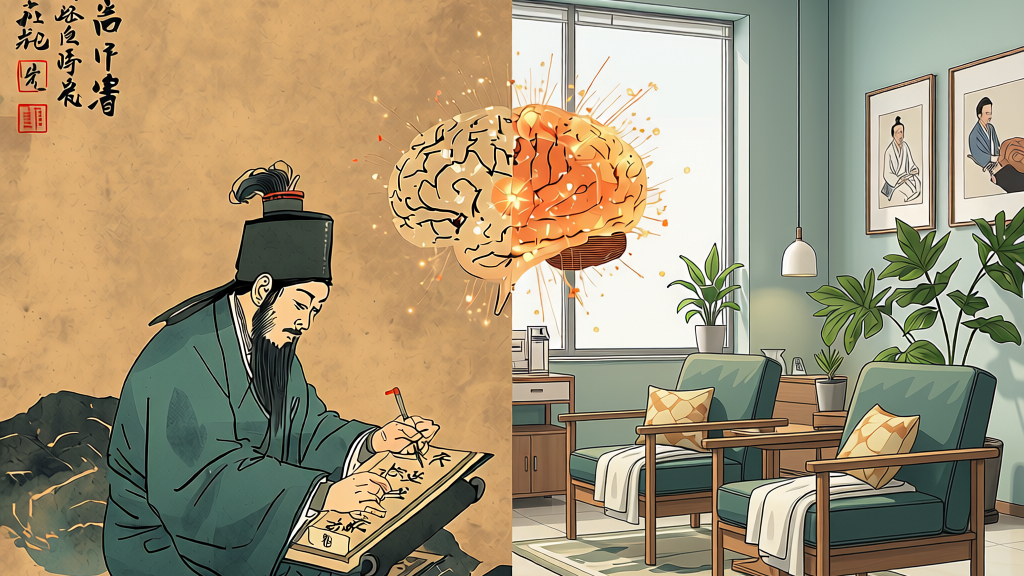
How a 2,000-Year-Old Medical Text (黄帝内经) Predicted Modern Cognitive-Behavioral Therapy (CBT)
When we discuss Cognitive-Behavioral Therapy (CBT), we naturally think of modern Western psychological science—Aaron Beck, evidence-based protocols, and cognitive restructuring. But if we open the Huangdi Neijing (黄帝内经), a foundational text of Traditional Chinese Medicine (TCM) compiled over two millennia ago, we find the exact same core truth: our thoughts shape our biology, and shifting our cognitive patterns can fundamentally heal our physical bodies.
As a clinical psychologist building my practice in Singapore, my goal is to pioneer the integration of these two seemingly separate worlds. By bridging ancient Eastern philosophy with modern clinical psychology, we can unlock a comprehensive blueprint for mind-body healing.
The Ancient “CBT” Framework: Mind-Body Inseparability
In the Western world, healthcare has traditionally isolated physical ailments from mental health. Conversely, the Huangdi Neijing operates on the absolute philosophy of the Unity of Form and Spirit (Xíng Shén Hé Yī, 形神合一). The text establishes that mental states and physical organs exist in a constant, reciprocal feedback loop.
When a patient is suffering from an emotional disorder (Qíng Zhì Bìng, 情志病), the Neijing asserts that physical interventions alone are not enough. It explicitly warns that if a patient’s spirit (Shén, 神) is deeply damaged or unyielding, physical tools like acupuncture needles will inevitably fail: “针不可以治之也” (needles cannot cure it).
The Suwen(素问)chapter goes a step further, boldly declaring: “精神不进志意不治,故病不可愈”—if the spirit is sluggish and the mind is not actively addressed, the physical illness simply cannot be cured. The mind is quite literally treated as the gatekeeper of physical recovery.
Historical Clinical Practice: The First Cognitive Restructuring
The Neijing did not just diagnose the mind-body connection; it outlined structured, psychological interventions. The primary “Heart Medicine” (心药) it championed is the Five Emotions Restraining Method (Wǔ Zhì Xiāng Shèng Fǎ, 五志相胜法).
This framework operates on the Five Elements cycle, where specific emotional and cognitive states are intentionally introduced to counteract and neutralize destructive psychological patterns. For example, a practitioner might cultivate rational fear (Water) to suppress excessive, manic joy (Fire), or use cognitive reasoning to break the grip of obsessive overthinking.
The text also heavily advocated for Verbal Guidance (Yán Yǔ Shū Dǎo Fǎ, 言语疏导法) and Attention Diversion (Yí Jīng Biàn Qì Fǎ, 移精变气法). Centuries later, legendary physicians like Hua Tuo(华佗)successfully used these exact principles to cure severe physical stagnation by intentionally shifting a patient’s cognitive and emotional states. This was not mysticism; it was ancient cognitive restructuring in action.
Bridging the Massive Blind Spot in Modern Healthcare
In Singapore’s current healthcare landscape, we frequently see patients treated as a collection of isolated physical symptoms. This hyper-focus on the physical body creates a massive clinical blind spot, ignoring the vital psychological architecture underneath.
This systemic neglect happens in both directions:
- It happens when psychological issues—such as chronic anxiety, depression, insomnia, or pain—are the hidden root cause driving a physical illness.
- It happens when those exact same mental struggles manifest as the debilitating by-products of living with a stressful physical condition.
In both scenarios, the psychological impact is deeply real, yet it is routinely left out of the recovery plan. Treating the physical “territory” while abandoning the “ruler” (the Heart and Mind) is a medical half-measure. Modern clinical psychology does not seek to replace traditional practices; rather, it is the standardized, evidence-based evolution of this ancient “Heart Medicine.”
Moving Forward: The Framework for Modern Integrated Care
To move past historical anecdotes and deliver truly holistic healthcare, we must actively merge ancient Eastern principles with modern Western psychological rigor. Progressive, collaborative models—such as the MIND HEALTH model right here in Singapore—demonstrate exactly how we can build this integration:
- Step 1: Quantifiable Assessment: We can upgrade traditional observation (Wàng Wén Wèn Qiè, 望闻问切) by layering in objective, standardized Western psychological metrics (like clinical anxiety and depression scales) to track mind-body progress with exact data.
- Step 2: Cognitive Rewiring: We can pair modern CBT techniques with the traditional concept of Yí Qíng Yì Xìng (移情易性 – shifting emotions) to systematically break repetitive, toxic cognitive habits.
- Step 3: Collaborative Shared-Care: We can establish clinical ecosystems where psychologists and TCM practitioners co-manage patients under a single, unified strategy—treating both the root and the branch simultaneously.
The Neijing taught us thousands of years ago what modern neuroscience is proving today: without a stable mind, the body cannot heal its roots.
Let’s Collaborate: Are you a healthcare innovator, Western clinician, or TCM physician in Singapore passionate about breaking medical silos? Let’s connect to build an integrated ecosystem that treats the whole patient—mind, spirit, and body.
References & Citations
- 《黄帝内经·素问》 (Huangdi Neijing Suwen): 汤液醪醴论 (Chapter 14: Discussion on Soup and Wine) — Establishing the principle: “精神不进志意不治,故病不可愈” (If the spirit is sluggish and the mind is not healed, the illness cannot be cured).
- 《黄帝内经·素问》 (Huangdi Neijing Suwen): 五藏别论 (Chapter 11: Further Discussion on the Five Organs) — Dictating the clinical necessity of psychological evaluation: “凡治病必察其下,适其脉,观其志意,与其病也” (In treating illness, one must examine the pulse, observe the patient’s mind, and understand their condition).
- 《黄帝内经·灵枢》 (Huangdi Neijing Lingshu): 九针十二原 (Chapter 1: Nine Needles and Twelve Yuan-Source Points) — On the limits of physical intervention without the spirit: “是故用针者,察观病人之态,以知精神魂魄之存亡…五者以伤,针不可以治之也” (Therefore, a practitioner must observe the patient’s state to know the presence of the spirit… if the spirit is damaged, needles cannot treat it).
- Mind-Body Inseparability (Xíng Shén Hé Yī, 形神合一): Framework analyzing Qíng Zhì Bìng (情志病 – Emotional Disorders) and the Five Emotions Restraining Method (Wǔ Zhì Xiāng Shèng Fǎ, 五志相胜法) as the baseline for indigenous Chinese psychotherapy.
- Integrated Clinical Case Studies: Historical documentation of ancient verbal guidance (言语疏导法) and cognitive shifting (移精变气法) as recorded in traditional medical lineages (e.g., historical medical records of Hua Tuo’s emotional counter-treatments)
About the Author
Dr. Jaswyn Chin
Doctor of Psychology (Clinical) | Registered Clinical Psychologist
Dr. Jaswyn Chin is a Registered Clinical Psychologist and Approved Supervisor in Singapore. As a pioneer in Psychology-TCM integration, she specializes in evidence-based therapies (CBT, EMDR, MBCT) for complex health conditions, trauma, and mood disorders