
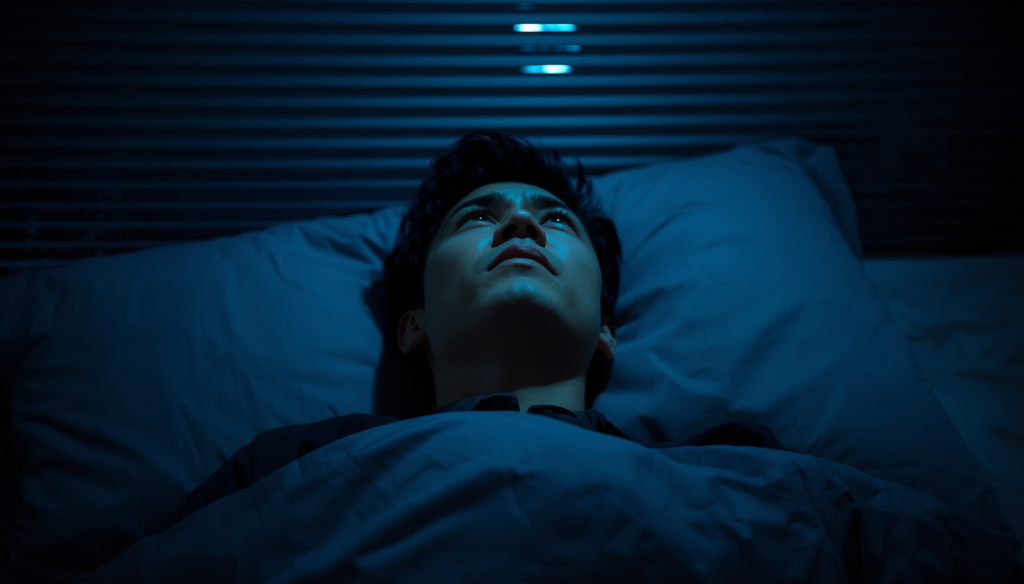
“Brain-Dead” at 3 PM, Wide Awake at 3 AM: The Sandwiched Sleep Paradox
Welcome to Part 3 of The Sandwiched Body series – where clinical psychology meets Huangdi Neijing. This week, we address the dreaded “night shift” of the sandwiched professional: waking up abruptly at 3:00 AM with a racing heart, a tight chest, and a mind that instantly kicks into overdrive. If you are tired of relying on melatonin or sleep trackers that tell you what you already know, let’s unpack the hidden mind-body mechanics behind hyperarousal insomnia.
The Midnight Alarm of the Overwhelmed
It is 3:00 AM in a quiet bedroom. You roll over, your eyes snapping open instantly. There is no external noise, and you don’t need to use the restroom. Instead, you are met with a sudden, frustrating wave of absolute alertness.
Within seconds, your heart begins to race and your chest feels slightly constricted. Before you can even attempt to close your eyes again, the “mental conveyor belt” starts running: Did I submit that budget proposal? What time is Dad’s specialist appointment tomorrow? How am I going to survive a 9:00 AM stakeholder meeting on four hours of sleep?
For the sandwiched working class, this is not just a bad night’s sleep. It is a highly specific physiological phenomenon. Your body is trying to rest, but your internal alarm system refuses to stand down.
It’s tempting to treat this as a generic sleep problem with a single explanation. It is actually a complex mind-body event with two equally valid explanations—one from a 2,000-year-old medical text, and one from modern sleep science. The most useful answer sits exactly where these two lenses meet.
The TCM View: Why 3 AM, and Why Anger?
The Huangdi Neijing’s (黄帝内经) foundational explanation for insomnia, found in the Lingshu (灵枢), focuses on Wèi Qì (卫气)—the body’s defensive energy—failing to properly move inward to join the resting Yin energy at night. When this internal transition fails, the text notes the result is Mù Bù Míng (目不瞑): the eyes simply refuse to close.
Later ancient physicians mapped a more specific layer on top of this called Zǐ Wǔ Liú Zhù (子午流注)—the organ clock—which assigns each two-hour block of the day to a specific organ’s peak metabolic activity.
The early hours leading up to 3:00 AM belong entirely to the Liver. According to Chapter 39 of the Su Wen (素问), the Liver is the precise biological domain where frustration, resentment, and anger are processed (怒伤肝 — anger injures the Liver).
When a sandwiched professional carries months of suppressed workplace frustration or stress from caregiving, their Liver Qi stagnates and escalates into Internal Fire. Fire naturally rises and agitates. When the clock hits the Liver’s peak operating hours, that hidden emotional agitation violently surfaces. This answers two critical questions at once: why you wake up at this exact hour, and why the content of your waking thoughts is so heavily shaped by anger rather than fear or sadness.
The Psychological View: Hyperarousal and Rumination
Clinical psychology doesn’t talk about Liver Qi, but it offers an incredibly precise account of this exact pattern. This isn’t just generic stress; it is a clinical condition known as hyperarousal insomnia.
Chronic, unresolved interpersonal conflicts keep your amygdala—the brain’s 24/7 threat-detection center—running hot around the clock. Around 3:00 AM, a natural, minor pre-dawn cortisol rise happens in everyone. In a relaxed individual, it goes completely unnoticed. But if you are already operating near your emotional stress threshold, that ordinary hormonal blip is enough to trigger a sharp noradrenaline spike. You are jolted from deep sleep to full alertness in seconds.
What happens next is where psychology tracks a mechanism that ancient texts lacked the vocabulary to explain: rumination as a maintaining factor.
Once you are startled awake, your prefrontal cortex immediately scrambles to find a logical reason for your physical agitation. It reliably locks onto the loudest unresolved conflict in your life—the unfinished work or responsibility of caregiving—and begins actively rehearsing it. This mental rehearsal is not neutral; it re-stimulates the exact same threat response that woke you up in the first place. Lying there “thinking it through” actively keeps you awake longer.
Why Neither Lens Alone Is Enough
If you look at this midnight wake-up call through only one lens, you miss half the cure:
- TCM brilliantly identifies that this is an issue of the Liver network and suppressed anger. However, simply naming “Liver Fire” does not give you a behavioral strategy to resolve the conflict with your sibling. It explains why the anger shows up at 3:00 AM, but not how to untangle it.
- Clinical Psychology is highly effective at interrupting the cognitive rumination loop in the moment through frameworks like Cognitive Behavioral Therapy for Insomnia (CBT-I). Yet, standard protocols view a 3:00 AM waking as a generic hyperarousal event. They rarely ask why the waking is uniquely anger-shaped rather than fear-shaped or grief-shaped.
Put together, you get a complete clinical solution: TCM tells you exactly why this hour and why this emotion are connected, while psychology gives you the practical tools to process the emotion and break the cognitive loop.
Three Steps to Silence the 3 AM Alarm
To successfully anchor your sleep, your lifestyle interventions must target both your internal energy and your cognitive behavior:
i. Externalize the Conflict Before Bed: Before you step into the bedroom, write down the exact conflict keeping you tense. Don’t write generic statements like “I’m stressed.” Write down the specific, raw details of the unresolved issue. This fulfills the TCM principle that stagnant energy must be allowed to move, while functioning as a well-established CBT-I technique (Scheduled Worry Time) to prevent midnight processing.
ii. Discharge Tension in the Early Evening: A brisk walk, light jog, or deep mobility stretching in the late afternoon or early evening serves both accounts. TCM views this physical movement as unsticking stagnant Liver Qi before nightfall, while exercise physiology views it as physically burning off accumulated sympathetic stress hormones before they can spike overnight.
iii. Break the Rumination Posture: If you wake up angry and cannot fall back asleep within 20 minutes, get out of bed. Both fields agree that staying in bed rehearsing an argument conditions your brain to associate your mattress with conflict. Move to a dimly lit room, write your running thoughts onto scrap paper to drain the adrenaline, and only return to bed once your physical heart rate has normalized.
Your 3:00 AM wake-up call isn’t proof of a broken sleep system, nor is it just a random emotional outburst. It is a combined mind-body alarm that requires both psychological strategy and energetic cooling to finally switch off.
Join the Conversation: When you wake up in the middle of the night, do you tend to feel a sharp spike of anger and find yourself replaying old arguments, or is it more often a flat sense of sadness and dread? These distinct emotional profiles point to entirely different internal organ systems and psychological patterns.
Next week, in Part 4, we move from the chest to the gut, exploring why corporate stress so reliably manifests as IBS and chronic acid reflux. Follow along to catch the rest of the series.
References
- 《黄帝内经·灵枢》 (Huangdi Neijing Lingshu): 邪客 (Chapter 71: Guest Pathogens) — Explaining the physiological mechanism of insomnia where defensive energy cannot transition into the interior: “卫气独卫于外,行于阳,不得入于阴…客于皮肤,沦于分肉…则目不瞑”.
- 《黄帝内经·素问》 (Huangdi Neijing Suwen): 举痛论 (Chapter 39: Treatise on Clarifying Pain) — Linking the specific emotion of anger to the physiological disruption and upward movement of Liver energy: “怒则气上…怒伤肝”.
Explore an Integrative Path to Wellbeing — Schedule a Consultation with Dr. Jaswyn Chin
About the Author
Dr. Jaswyn Chin
Doctor of Psychology (Clinical) | Registered Clinical Psychologist
Dr. Jaswyn Chin is a Registered Clinical Psychologist and Approved Supervisor in Singapore. As a pioneer in Psychology-TCM integration, she specializes in evidence-based therapies (CBT, EMDR, MBCT) for complex health conditions, trauma, and mood disorders